
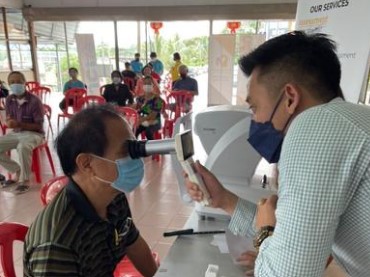
“Please check my power.”
At community events, we tell people that looking after our eyesight is more than just knowing your eye power.
Vision care professionals must help people manage their eye power to avoid serious eye diseases that can cause impairment and blindness.
One billion people worldwide in developing countries need vision correction. According to the World Health Organization (WHO), uncorrected vision is responsible for literacy problems, a widespread loss of labour productivity and other issues such as road and domestic accidents.
Here are some facts as to why vision care is essential:-
Literacy in Young Children
Students excel when they have a clear vision, and working adults perform better. According to National Geographic, studies have shown that clear vision can reduce school dropout rates by up to 44 per cent; clear vision can help people earn 20 per cent more per year and be 35 per cent more productive.
Vision skills are required to perform successfully in school. As children progress through school, they should regularly check for vision problems. Vision care screenings or examinations should include multiple tests to identify a broader spectrum of vision problems, especially those affecting near-vision, such as #myopia (short-sightedness), a common problem in young children.
Productivity in Working Adults
Studies show a reduction in the employment of working-age persons with vision loss by 30.2%. These findings support the view that blindness and moderate to severe vision impairment (MSVI) have a sizeable economic impact worldwide.
Work conditions require long hours of looking at digital device screens with no breaks. Some drive long distances and do activities that require focusing for a long time. Other vision-impacting working conditions include bright lights, glare or dim lighting. These are specific working hazards, so adults must check their eyes regularly.
Safety in Older Persons
Eye diseases and conditions in older adults can lead to vision loss and blindness. These conditions may have few or no early symptoms. Studies show that increased visual impairment is significantly associated with an increased incidence of falls and other injuries.
In older persons, visual acuity alone, i.e. 20/20 vision, is not a good predictor of a person’s degree of visual difficulty. Other visual factors, such as poor depth perception, limited side vision, extreme sensitivity to lights and glare, and reduced colour perception, can also limit a person’s ability to do everyday tasks.
VismateEducates: Here are links to some helpful reading resources. Feel free to share questions, if you have any.
https://www.thelancet.com/journals/eclinm/article/PIIS2589-5370(21)00132-2/fulltext
https://www.mayoclinic.org/diseases-conditions/eyestrain/symptoms-causes/syc-20372397
https://iovs.arvojournals.org/article.aspx?articleid=2187178
https://www.aoa.org/healthy-eyes/eye-health-for-life/senior-vision?sso=y
